Showing posts sorted by relevance for query Through the Lens. Sort by date Show all posts

18.6.12

Through the Lens: Nyani Quarmyne


As part of the day-job, my head has been in "climate change" for quite some time so I was thrilled to come across this piece (it will probably help to read the article right about now) featuring the work of Ghanian photographer Nyani Quarmyne documenting the gradual erosion of an entire village in coastal Ghana. Looking at these homes, it is difficult to image that these houses were once 3 miles from the ocean!

While this type of erosion is certainly not new (see Helga Kohl's documentation of the same challenge taking place in Namibia or National Geographic's journey through The Sahel), Quarmyne adds a unique angle by photographing individuals in their sand-invaded homes. According to the artist:

“I tried to create images that look someone in the eye and through the connection that’s created — experience for a moment what they’re going through,” he said. “I was trying to humanize, to personalize, to individualize, rather than get away from the big picture, the common stereotypes that I see.”

I found myself very intrigued by the idea that by having a person in a picture, especially one in which the subject is looking directly into the camera, may "humanizes" an image. In this case, I personally found the structure of the images less personalized. When a person is posed, I tend to associate that more with the artist (in this case a photographer) creating a work of art in which his own version is included, rather than being a 100% caption of how that person is without the artist. I guess since I tend to look at more photojournalists images, I have come to associate their work with the realm of fully humanizing an experience. In addition, at times, the absence of a person can be just as powerful as I found to be the case with Helga Kohl's work and why I'm often so drawn to images of abandoned spaces.

Nevertheless, Quarmyne certainly captures a phenomenon in a distinct and beautiful way and makes me ponder the reality of the lives of those from this village as well as other areas whose lives are being uprooted by environmental changes beyond their control....

{Photos: Nyani Quarmyne via (including quote) The Lens}

23.11.09

Through the Lens: Bruno Boudjelal


For the longest time, I thought a blurry picture was the same as a bad picture. I would get frustrated when an image on a roll of film came back blurry and even my digital point-and-shoot got into the act by giving me instant erase options whenever a picture was blurry.

These days I feel more able to see the beauty in these types of pictures and no photographer makes it quite as stunning as Bruno Boudjelal. Boudjelal, who is French by way of Algeria, has a unique ability to capture the ordinary in a way that turns it into extraordinary. According the to photographer, his technique is more "intuitive" than technical. He does little to no framing and often doesn't even look through the lens! That's a whole lot of intuition as far as I can see, yet that ability to completely trust himself has led to stunning work.

Boudjelal's story is quite interesting and definitely comes out in his photographs. Born to a French mom and Algerian dad, Boudjelal knew nothing about his Algerian heritage when he was growing up as it was held secret. He never knew anything about his father's past in Algeria or any of his father's relative. It wasn't until he was in his early 30s when he made his first journey to Algeria to discover this origins, including one trip with his father which can imagine was very heavy with emotions.

Since his first trip to Algeria in 1993, Boudjelal returned on a consistent basis to explore his heritage documenting each step along the way through the lens of his camera. Meeting new family members and strangers as he traveled the country from east to west. Ten years later, feeling like he had planted enough roots in Algeria, he began exploring other countries on the continent including Ghana where many of these shots are taken. This is definitely a photographer to watch, especially as he discovers Africa one country at a time!

So what do you think of this "intuitive" type of photography? Have you ever taken any pictures similar to this style and then seen it as beautiful??

{Photos: Agence VU'}

18.4.11

Through the Lens: The Sahrawi


As a new week gets started (ok, mine technically started yesterday), I find myself yet again amazed at how exciting putting a post together can be! The simple (ok, not always so simple) transition from finding something that I'm so excited about I feel like I could burst and then putting it together to share with you is a constant reminder of why I still love blogging.

Today's Through the Lens features the latest work by Irish-born, Kenyan-based photographer Andrew McConnell. I learned of his work via The Lens and I knew that I had to highlight his work. This series focuses on the Sahrawi people of Western Sahara and stunningly brings a bit of humanity to a group who continue to survive under some pretty tough political conditions. For me, McConnell's brilliant capture of just a few, sheds enormous, warm light on an entire group.....isn't it brilliant that photography can do that?!?!


You can see even more of the pictures from this series on McConnell's site and definitely catch the The Lens post which includes commentary from several of the subjects of these images.

{Photos: Andrew McConnell}

21.9.09

Through the Lens: Helga Kohl


This weekend I was all about photography. I had finally picked up some film for my Nikon and order a second round of film for my polaroid camera which I'm loving to a ridiculous degree. I kept seeing things and thinking about how it would look through the lens of my cameras. While I've gotten a few amazing shots with my polaroid, that ethereal look that I really love is definitely hard to caption and requires you working like a mad person to catch the sunlight at just the right moment as well as hoping that the image turns out to be even a third as good as you have it envisioned in your mind. But when it actually works...it's brilliant.


One thing that my eyes seem to naturally target are abandoned buildings or buildings that look like they are in some state of disrepair. It something that I always find fascinating so my love of Namibian photographer Helga Kohl's work should be of no surprise. Her photographs of the ghost town of Kolmanskop in southern Namibia really reflects what happens when mother nature takes over.


Back in 1908, diamonds were found in the area and within two years, an entire town was built to house all the workers trying to make it rich. But as the case with many natural resources a bottom was just in sight. After World War I, the price of diamonds hit the ground and left many of the workers having to seek fortune through other means (or at least in other towns). By the 1950s the town was pretty much done for it and that's when sand began to take over. Now the town is a tourist destination.


What I love most about Kohl is her ability to highlight the beauty of the space as it is town, abandoned, eventually to be hidden by sand. Each image looks like a grand portrait of that particular corner of someone's home.


So what do you think of Helga Kohl's work? Are there any interesting abandoned spaces near where you live? If so, I'd love to see a shot, so please do share!

{Photos from Bremische Buergerschaft, Fotoinfo, CCCB, Alliance Francaise SA}

12.7.10

Through the Lens: Football


With the finale of the World Cup yesterday, I feel as if the world needs a moment of silence or something to recognize the end of something truly magical. There were so many wonderful moments including the very last when Spain took home the grand prize for their first time. Watching goalie Iker Casillas weep like a newborn then raise the trophy above his team to thousands and thousands of fans...well, clearly I got a little emotional. To add to the sweetness of that moment are so many joys that came before throughout a tournament that literally had me jumping with joy at one moment and weeping with utter sadness at the next. The fact that all of this happened on the continent of Africa makes it all the sweeter. While an African nation did not earn the final prize, to say they put up a good fight is clearly an understatement. More importantly, I really hope the rest of the world got to see a little of the magic that I have always seen in my home continent. That despite all the negativity that may surround the continent and South Africa, the optimism outshines the doom and gloom every single time.
Though the games may be over for now, football will continue to be played all over the continent. What I most hope is that countries around the continent begin to really invest in young players the way they do throughout Europe and Latin America. I am convinced that for every talented player that heads to Europe, there are dozens of young potentials playing on beaches and fields that lie undiscovered. Maybe with greater investments in coaching and youth leagues and building up of national leagues so that in addition to cheering on Manchester United or Real Madrid, African fans will also have their own top-notch clubs to root on within their own continent. It might seem like tall order , but when it comes to Africa, I'm all about reaching for the moon.


As an end to my sentimental spiel, I'd like to highlight these amazing pictures by Dutch photographer Jessica Hilltout. Using a 1978 Hasselbald, Hilltout travelled to 10 countries on the continent to document the passion for the sport. When I first saw these images, I literally got choked up with that "ohh I miss Africa" feeling that overwhelms me at times. The images of balls made from plastic bags, old rice bags and basically any thing a hand can find really reminds me of how simple life can be - a ball is all it takes to reach the highest heights of joy!

24.5.10

Through the Lens: Luís Basto

Hi there! Welcome to a whole new week here on Out & About Africa! How was your weekend? Mine was a little tough since I was battling a cold. It was a brutal fight and included me spending the majority of Friday curled up on the couch in full defeat, but with a whole lot of sleep, I have managed to turn the tides to my favor; one more nasal decongestion dosage and victory will be on the horizon!

While fighting my cold, I also got to hang out with a friend who came to visit from NYC. It's always so wonderful to have visitors and this was no exception. Between hanging out and getting to see DC through her new-to-the-city eyes it was a great time. I even managed to try out a new zucchini bread recipe which turned out delicious!!

Anyway, back to the focus of the day: Photography! Today's Through the Lens is all about Mozambican photographer Luís Basto . Aren't these images amazing? I just love this image of the kid very seriously posed overlooked the ocean and then you see the other kid doing a completely goofy backward jump! It's great. I also love the intensity of the second picture with everyone so focused on what looks to be a dhow race!


{Photos: artafrica}

2.5.11

Through the Lens: Sahel

Good morning (or evening)! I hope everyone had a great weekend! To get this week rolling, come along with me on a photographic during through the Sahel. Sahel means "shore" in Arabic, but unlike the images of crashing waves, the "shore" in reference is the coastline where the desert sands of the Sahara come to lick the green vegetation that welcomes one to "tropical" Africa! This stretch of land spans from the Atlantic in Senegal straight across the continent to the Red Sea in Eritrea and hits a whole bunch of countries, peoples, cultures, and more in between.

In a brilliant piece by Paul Salopek with photos by Pascal Maitre for National Geographic, Salopek mixing a bit of history of the region with current day joys and challenges. What these pictures really bring out to me is the amazing role topography plays in the history. In the past, Arab crusaders could handle all this sand, but when it hit upon the green tropicals, one bug could stop their flow. In the present, communities have to struggle to stop the desert sand from further encroaching on the green land or that in some areas, the greenery is claiming land from the desert! That people are able to "see" borders where the ignorant only see sand is also another fascinating aspect to Salopek's story....


Definitely check out this piece to learn more about this fascinating region and to see even more stunning photos!

{Photos: Pascal Maitre for National Geographic}

14.12.09

Through the Lens: Harper, Liberia


For today's Through the Lens, I'm going to flip things around a little and instead of showcasing a particular African photographer, I'm going to show you one of the places in Africa that I would most like to visit: Harper in Cape Palmas, Liberia.

I know you are thinking..."why does this chick want to visit a bombed out town that's practically impossible to get to?" Well, that alone is about 60% of the appeal. I'm fascinated by war-torn spaces and the fact that a place is hard to get to definitely ups its appeal to me. The rest of the reasons are a combination of several factors. I've heard about Cape Palmas most of my life and even went there as a young kid (although my memory is very very vague) and it's always seemed like a really distant but intriguing place to visit. The fact that it this is a coastal area has a colonial past dating back to the 1400s via the Portuguese is also a another major part of the appeal for me.

Until that voyage begins, I have these great shots by Monrovia-based photographer Glenna Gordon who provides other stunning images of the country via her website and blog.

:: Please note that all photos by Glenna Gordon have been removed at the request of the photographer. Please continue to visit her site to see more images of Harper and Liberia ::

{Photos: blkliberia}

6.2.12

Through the Lens: Hereros


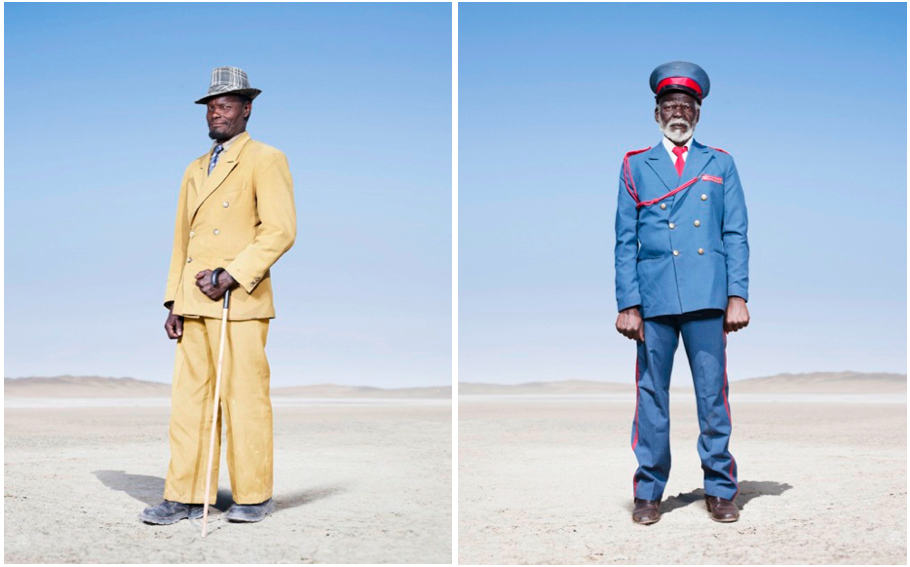
Whenever I visit a new-to-me African country, I'm always surprised and interested in the strong links that continue to remain between that country and the country that colonized them. The English, French, and Portuguese cultural influence on the continent continue the exemplify the depths of a colonialist past. Yet, the influence of the Germans in Namibia easily goes under the radar until one come across amazing projects like Hereros by photographer Jim Naughten.


Upon settling in Namibia in the late 19th century, German missionaries quickly got down to the business of converting the various tribesmen. This conversion including the provision of Victorian clothes worn by the Germans of that era. As war broke out between the Herero and Germans, the Hereros would take the clothes of slain Germans and wear it to prove their victory over the enemy. The dresses could a little horn-head wear to reflect the important of cattle to the Herero.


Today, these clothes continue to be worn during important events as a sign of reflect for ancestors. While the paradox of the whole scenario continues to reverberate through my head, one cannot deny the power that the Herero clearly gained from the appropriation of these clothes. That Naughten has so brilliantly documented this history is also something I find very profound.


{Photos: Jim Naughten via Creative Roots}

4.10.10

Through the Lens: Uzoamaka N. Okoye


Today's Through the Lens feature is very special not only because these are pictures from Liberia, but also because I have known the photographer for a very long time (i.e. my entire life)! My sister recently went back to Nigeria and Liberia and had the chance to take some amazing pictures. What I found interesting, especially in looking at the ones of Liberia, was the complete lack of familiarity. I had initially thought I would feel something given that the images were of people and places I should be familiar with. While of course the people were the same family members that have always been in my life, the images of the country felt so distant. While this is a country that I spent the first 10 years of my life, I guess that these images are another reminder that I definitely need to return and get to know this country.


{Photos: Uzoamaka Okoye}

7.12.09

Through the Lens: Samuel Fosso


Today's Through the Lens focuses on Cameroonian photographer Samuel Fosso. You know those weird kookish little things you do just for fun and then get sorta embarrassed when someone else finds out about them? Well Mr. Fosso's little quirk has led him to become one of the top famous photographers coming out of Africa. While working as an assistant in a portrait studio, Mr. Fosso would set up a full stage and use himself as the main star in a full interpretation of whatever was going on in his head at the time...imitating people from all walks of life and using anything he could find as props. The result are photographs that show such an artistic side of photography (dare I say fashion photography). Considering all the weird, over-the-top fashion editorials I've seen over the years, I think Mr. Fosso's is right up there with the best of them!

30.11.09

Through the Lens: David Goldblatt


Every week I'm faced with the same struggle - which amazing photographer will be featured here today. I end up spending so much more time then should be required trying to figure out which photographer I'm most excited about. Today was especially difficult as the final two candidates works are just amazing. South African photographer David Goldblatt won out mainly because I needed to make a choice so I could eventually get on to other things (like sleeping). I also loved the fact that Goldblatt has used his cameras to record the changes in South Africa (and other parts of the continent) for more than 40 years. As someone who at times feels all over the board, I'm completely in awe of Goldblatt's complete dedication to not only the field of photography but also the subject of his home country in particular. His work has captured South Africa both pre and post apartheid and capturing the lives of both black and white individuals, families, and communities. What makes this especially interesting is that during a transition when so many images coming out of South Africa focused on the violence of this change, Goldblatt instead used his camera to show how citizens on ever side of the divide were attending to the day-to-day business of living.

His work has mostly been in black and white however Goldblatt is not letting the digital age go by as he eventually started working in color. In reading interviews and other information about this photographer, I was particularly interested in how he went from a world where all your work had to be done in black and white to switching to color. He has done it very slowly and only in a manner that stressed the importance of capturing the colors as close to reality as possible (no uber blue skies for this guy).

In addition to being featured at just about every major art museum in the world and written about in major newspapers and magazines, Goldblatt's work was recognized by the kind folks over at the Hasselblad Foundation who awarded him the International Award in Photography (basically a Nobel Prize in the field) in 2006. This summer, Goldblatt also received the prestigious Henri Cartier-Bresson (a major heavy-weight in the world of photography) award which will allow the him to continue his documentary on the city of Johannesburg.

{Photos copyright David Goldblatt from: Brian Rose, New York Times}

19.10.09

Through the Lens: African Autumn


The northeast of the U.S. is currently in the gripe of what is one of my favorite seasons: Autumn (summer being the other). I am constantly amazed at how beautiful the region becomes in preparation for a long winter. My bias to the season started when I first moved to the U.S. and moved to the state of Massachusetts. There is little doubt that New England has the best autumn and my school at the time made sure I enjoyed everything that the season has to offer. While autumn is D.C. is nothing like autumn further north, I'm definitely impressed with what Virginia has to offer. I was out for a bike ride recently and the fresh crisp air, beautiful turning leaves and great scenery was more than I could ask for for a happy ride.

As is usually the case, I ask myself what would autumn look like in Africa. My experiences growing up in Liberia and spending time in East Africa have shown me the dry season and rainy season and I've even experience a Nairobi winter (nothing to sneeze at consider central heating hasn't become quite the rage yet). Yet could there be an autumn like those I that experience here?!?! Maybe not quite, but as these beautiful images show, people in countries like Morocco, Tunisia, and South Africa definitely get to experience some stunning fall views. I especially love the first image of elephants wading through a fall plain!

So you do get to experience autumn in your part of the world? What does it look like? Any favorite memories?